I may post occasionally to highlight material being published elsewhere that is likely to be of interest to readers of this site.
If you spot something else that you think I should share, get in touch.
Rudy Kraft interview
Back in March, the Grognardia blog published a two-part interview with Rudy Kraft, writer of Snakepipe Hollow (1979, with Greg Stafford), and co-designer of Griffin Mountain (1981, with Jennell Jaquays and Greg Stafford).
It’s a very informative read, and I aspire to including similar interviews on this site, if I can.
An indication of the thorough, forensic approach is that it was only in the fourth post in the series that Ludo actually opened the RuneQuest rulebook and read the first chapter!
The fifth post is a particular treat, as Ludo looks at RQ2’s map of Glorantha, and compares it with others from throughout the history of core Gloranthan RPGs.
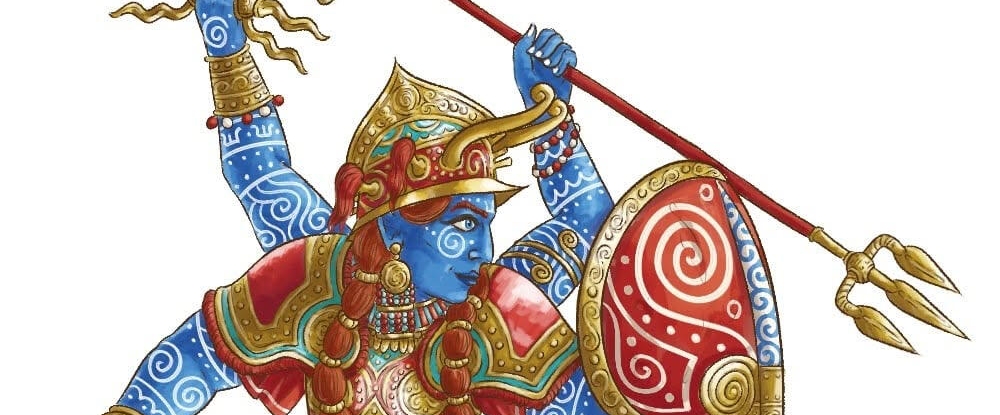
Vinga
Vinga pictured by Katrin Dirim, (c) Moon Design Publications LLC
Dr Nightstone studies Vinga through the ages, how the deity was created and developed across a range of different periods:
2026 Greg Stafford Memorial Award for Gloranthan Fandom
The Gloranthan fan community has some very creative people, and it was a joy to give them a platform to come together (and raise money for the charity Médecins Sans Frontières) in the book I published just a couple of months ago, Jonstown Voices. Getting an award for it was definitely the icing on the cake!
There are many in-world histories of Glorantha, but few if any histories of the setting and how it evolved over real-world time. I made my own attempt at a short history back in December 2024, posted on BRP Central.
I’ve revised and refreshed it here, but with the same aim. It’s not a blow-by-blow account of what Greg Stafford and his collaborators did and when. Instead it considers what were the trends in how Glorantha was creatively assembled over time.
I’m not a deep Gloranthan expert, but this is my attempt to frame that. By sharing it now, it will hopefully serve as a useful foundation for some future posts.
Before creation
From 30,000 years before the invention of writing to 1966.
The void, or the primal plasma. Much of what eventually coalesced into the Gloranthan paracosm had a long prehistory. The long development of humankind’s collective unconscious into a collective consciousness. The growth and multiplication of the prima materia which Gloranthan creators would later plunder.
“The 30,000 years that preceded writing was the mythical age. It was when people […] had a different awareness of myths to remember how to live properly. And it’s awesome to think of this as 30,000 years because much of this mythology will include notes about our biological and evolutionary reality”. 1
Before he first discovered Glorantha, Greg was very strongly interested in classical myth and legend.
“You know, Homer’s Iliad and Odyssey first, the Greek Playwrights, and so on. I began reading these while still in grammar school. By High School I had devoured Beowulf and the Niebelungenlied, the Eddas and the Vedas, Gilgamesh, and all that”. 2
Greg had a particular enthusiasm for knights and King Arthur, dating back to his childhood.
“By the end of grammar school I absorbed Howard Pyle’s version of the stories, along with Bullfinch’s, and read everything else similar, such as Pyle’s Men of Iron, and Hugo of the Silver Hand, and Mark Twain’s A Connecticut Yankee in King Arthur’s Court“. 3
The Roots of Glorantha
1966 to 1976.
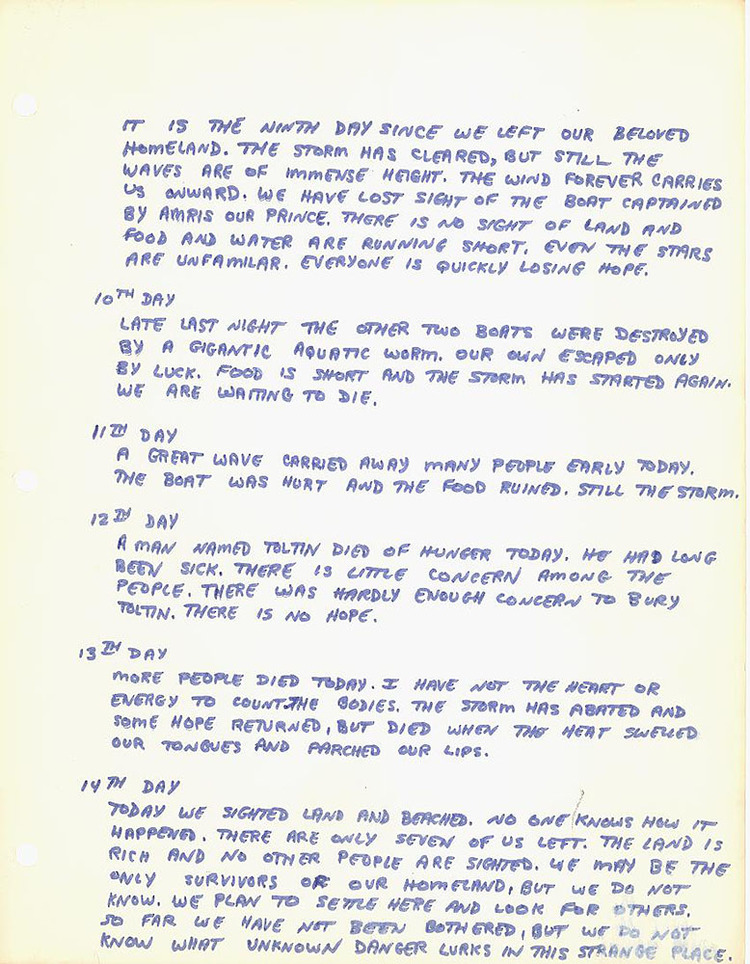
Glorantha was first discovered one night in 1966, when 18-year-old Greg Stafford wrote about an explorer accompanying a boat-load of refugees fleeing (what he later understood to be) the destruction of Seshnela, a western land in what he would later name Glorantha.
The first Gloranthan tale, 1966 (c) Greg Stafford. Source: The Stafford Codex website via archive.org
Greg often claimed not to have read any fantasy fiction prior to starting his studies at Beloit College in Fall ’66.
“In college I met Elric, then Bilbo and Frodo, then Conan, in that order. Those were the years when Lin Carter was editing the Adult Fantasy Series for Ballantine. I was lucky enough to get exposed to the old masters like Dunsany, Lovecraft, Smith, and then the rest of Moorcock’s tales”. 4
The world of Glorantha (initially called Acos, or Glorinthael, or Glorinthaela) was discovered mostly by recording its history, through slightly medievalist fantasy tales, genealogies, and other fragments: endless pages of text, with occasional maps.
Much of this material is still present in later versions of the setting, but often hidden, or buried, or fossilized, or evolved. It forms a deep-lying stratum that underlies everything laid down later. It was later described by Greg (in his introductions to the Roots of Glorantha books) as “the deep skeletal origins of the world”.
Equally, a great deal of this early writing remains essentially invisible in the later setting. The first encounters with Argat and Gbaji, circa 1970 while recovering from serious ill health, would prove the most impactful in the longer term.
The early material is still thrust to the surface in some places, most notably for me in 2014’s The Guide to Glorantha. This early writing was the work of a single creator but it was still a world in flux. Details of history, names of gods, everything was vulnerable to change.
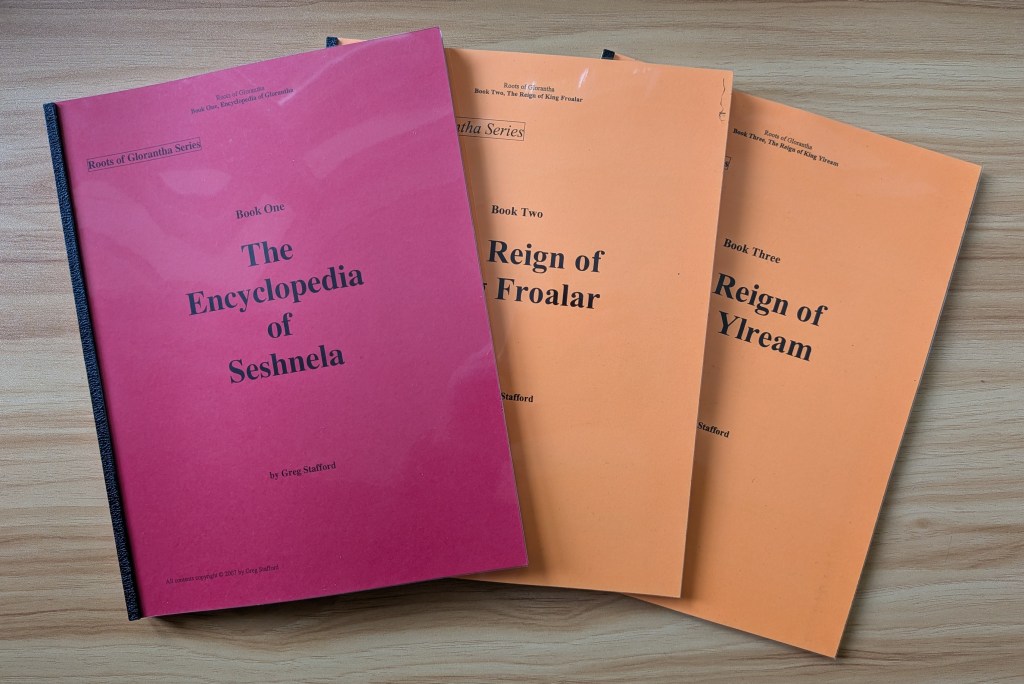
Roots of Glorantha Books One to Three, 2007 “rainbow” edition. A selection of Greg’s early writings were printed for the first time, and sold to a very small audience. Another small-circulation set was made available to top-end backers of The Guide to Glorantha kickstarter in 2015.
The introductions to the Roots of Glorantha books cite the years “1966 to 1976, or so”. Most of the early Gloranthan material was written by Greg, seemingly mostly for his own interest, although occasionally for an audience of one other.
“I kept working on it for years all on my own. I would read portions to my girlfriends, because it was a cheap date. Generally, though, it was not well known, not well shared”. 5
Later in life, Greg recalled a very early vision of a more expansive future for Glorantha.
“One day I was standing next to Blaisdell Hall in Beloit College and the whole world opened up for me. It was like I had a tiny little peek hole in the stories I wrote, and suddenly it was, vast, infinite. At that time I remember thinking very clearly, wow, this thing is so big that it’d be so cool if someday there was a whole staff of people to work on this thing … you know, dozens of people that were familiar with it and would be able to contribute to it”. 6
Dragon Pass, Prax, and new explorers
1975 to 1977.
Dragon Pass (White Bear & Red Moon, 1975) and Prax (Nomad Gods, 1977) were discovered.
“The first version [of WB&RM] wasn’t set in Glorantha, but in a new fantasy world of empire versus barbarians. But it didn’t take too long for this to conjoin with Glorantha. I abruptly realized one day that my in-design game map would fit right into a notorious blank space in my setting, and thus was born Dragon Pass, the Orlanthi and the Lunar Empire.”7
By the time of Nomad Gods in 1977, the connection of these games to Glorantha was clearer.
In the early 1970s, Greg had tried selling his fantasy fiction, presumably his Gloranthan material, to magazines. For the most part he met with rejection. Following one especially notable rejection 8, he decided to pursue a different outlet.
Greg later said that he had been struck by the idea of “using the systems of sword-and-sorcery hackwork and mythical archetypes to create a do-it-yourself novel”9, i.e. interactive fiction in the form of a game, White Bear & Red Moon.
The seeds of much of later “core Glorantha” were found in these two boardgames and in the magazine Wyrm’s Footnotes (1976-1982). There were gods, but often not as they would be known later: e.g. the “Six Dawngivers”, and the “Soul Arranger” (later a.k.a. Larnste).
For the first time, others were able to enter Glorantha for themselves and explore the epic sagas of the Hero Wars, but only in a limited way, constrained by the limitations of chits and dice. The events and outcomes might change each time the game was played, but the pieces and the maps did not.
The territory was tightly defined and the maps weren’t yet intended for others to extend or annotate. But assembling and releasing games was not a solo effort, and several of Greg’s friends had helped to playtest and assemble both games.
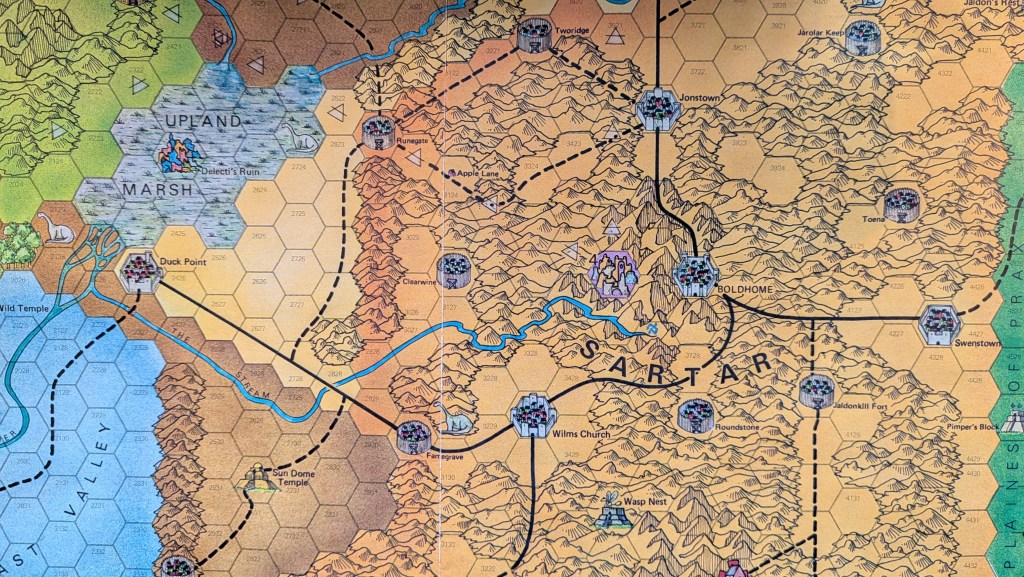
The first marks clearly made by others in Glorantha were mostly names of places, all named after Greg’s close associates: Swenstown, Jonstown, Biggle Stone, Alda Chur, Pairing Stones, Wilms Church, Pimper’s Block, Cam’s Well, Hender’s Ruins, Tourney Altar, Tada’s High Tumulus 10.
William Church’s map for the 1980 edition of Dragon Pass, formerly White Bear & Red Moon, (c) Moon Design Publications
Of the contributions by others, I wonder whether William Church’s art for the chits and maps had the most lasting influence on the setting. Although credit is also due to Brian Crist, whose suggestion of a city called Duckburg (swiftly amended to Duck Point), would be responsible for the introduction of one of Glorantha’s defining non-human races.
The first great exploration
1978 to 1983.
A portal was created, in the form of the role-playing game RuneQuest, whereby visitors could not only enter Glorantha, but could explore parts of it which were previously unknown even to its creator, making their own discoveries. Most of their discoveries went unpublished, but some of their findings would soon be made “official”.
From 1978 onwards (from Wyrm’s Footnotes #4), it was explicit that the territory of Dragon Pass and Prax were part of the wider Glorantha, as Greg began to report in greater detail on the world’s geography and myth.
The God Learners were revealed in Wyrm’s Footnotes #5, appropriately enough, as a freshly organized understanding of Gloranthan myth and history was now steadily pursued and revealed. Most of it bore only a glancing connection to the Roots of Glorantha phase.
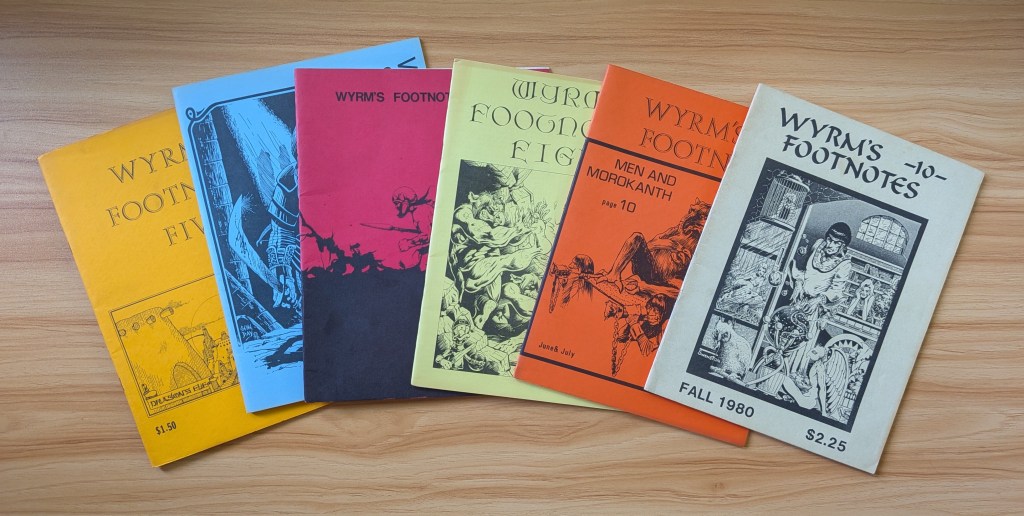
Wyrm’s Footnotes, issues 5 to 10, 1978-1980
Examples of parts of the world which were explored and defined by others at this time include Pavis (Steve Perrin), Snakepipe Hollow (Rudy Kraft), Balazar and the Elder Wilds (Rudy Kraft and Jennell Jaquays), etc. This was virtue made out of necessity: if you allowed others freedom to explore your sandbox, they would of course find things you didn’t know were there. And if you wanted to make money from the setting as the owner of a games company, relying on a sole creator as a long-term bottleneck isn’t a great plan.
Greg’s late-60s vision of “a whole staff of people to work on this thing” was coming true. The result was that the creator often became editor, as with books that were essentially compilations of input from others: Cults of Terror, or Borderlands.
For me, the best of this material had a narrower voice and strong input from Greg himself: Cults of Prax (with Steve Perrin), and Trollpak (with Sandy Petersen). However there was sufficient editorial control that all of these publications remain recognizable as the world of WB&RM and Nomad Gods. Key parts of the setting were now crystallising rapidly:
“I wrote volumes of history, maybe a million words, and every so often there would be something new for me about [the trolls]. In one very old tale, about the Fronelan Jonat, two things appear which are like trolls, but are quite different. Now only one of those is a troll, the other is a different monster”.11
The Roots of Glorantha material (largely set in the West of Glorantha’s northern continent) was largely pushed to one side by the focus on Dragon Pass and Prax, but the connections to it were still visible. Ralios, Seshnela, Altinela, Gbaji and more all appeared in the RuneQuest 1st or 2nd edition world maps and text. The Serpent Kings, the Hykimi and Gbaji, mentioned briefly in Cults of Prax, also connect back directly to the Roots. The history and cosmology in Cults of Terror cross-referenced Brithos, Hrestol, the Sunstop, Arkat, the krjalki, and other forebears from the Roots material.
Circa 1980, there were even plans to publish a Brithini / Western supplement for RuneQuest, written by Charlie Krank, and repeated promises to share Fronelan material in Wyrm’s Footnotes – all of which came to nothing.
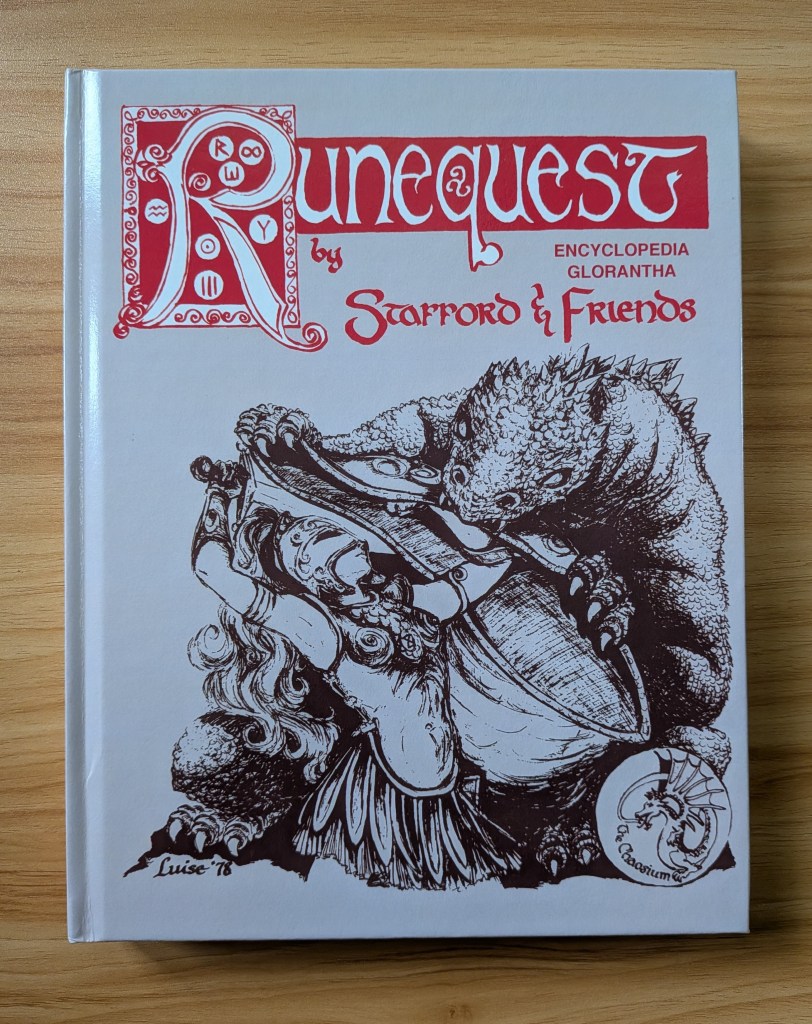
Encyclopedia Glorantha: 2016 reprint edition available to high-end RuneQuest Classic kickstarter backers. Cover art by Luise Perrin
Although other voices were now very much present, Greg was clearly hard at work weaving his world closely together throughout this time. Around 1980, he was assembling a reference work for others, The Hero Wars: A Gloranthan Encyclopedia, the beginning of an encyclopaedic urge that soon fed into other books.
The first age of canon
1984 to 1990.
The God Learners had been first described in print way back in 1978, in Wyrms Footnotes #5. It was recorded that the God Learners had “evolved the Mythical Synthesis Movement”, an attempt to reconstruct “the mythical realities of the Gods Age”. Perhaps this was an echo of the coherent version of Glorantha that Greg had been steadily building, working hard to integrate the work of colleagues like Kraft, Jaquays and Perrin into his world vision.
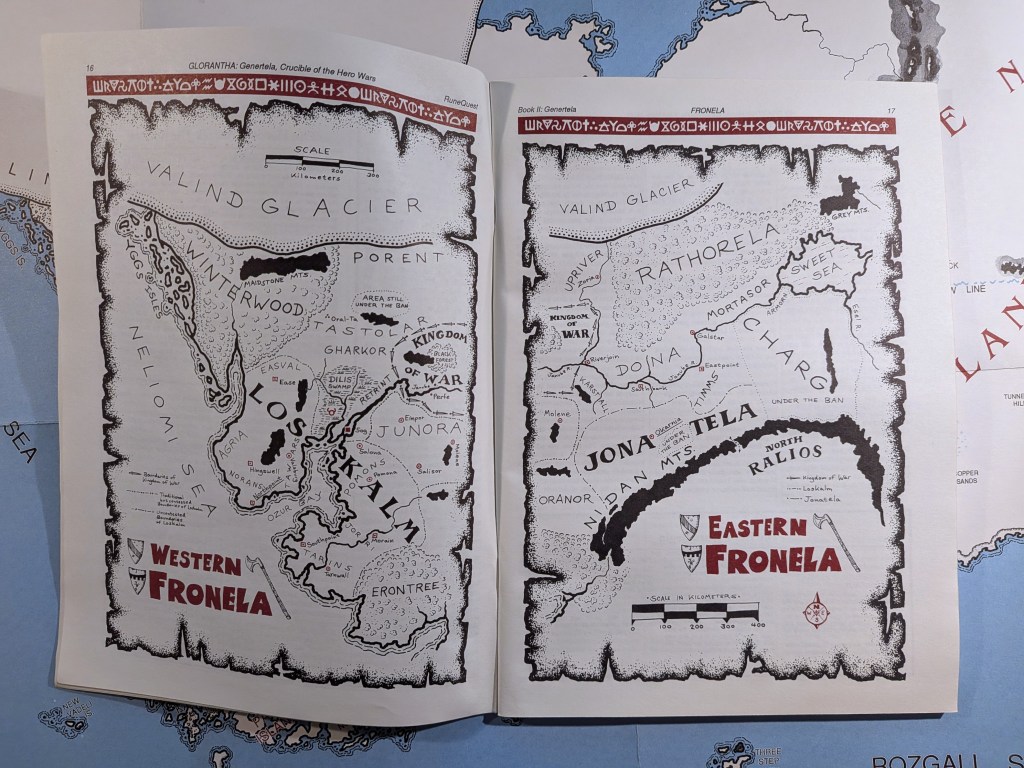
Maybe something of that impulse lay behind Gods of Glorantha (1985), Glorantha: Genertela, Crucible of the Hero Wars (1988) and Elder Secrets of Glorantha (1990). Amongst other things, there was enough broad detail here to bring together still more of the Roots of Glorantha material with the fruits of the Dragon Pass / Prax period.
Further material, covering Pamaltela, the Islands and Oceans, was prepared but left unpublished (until it was released as the part-finished Missing Lands in 1998).
Snodal’s ‘hood once again. Fronela maps from Glorantha: Genertela, Crucible of the Hero Wars
Much of the content of the Genertela book drew upon the early Roots material, but heavily evolved (most of Roots depicted the setting’s First Age, rather than the Third Age, and there was also the benefit of hindsight). Loskalm, Seshnela, the Brithini, Kralorela, Teshnos, the Luatha, Ralios, the Basmoli / Pendali lion-men: there are plenty of throwbacks, all well-integrated.
Documenting the world remained a collaborative effort: for the three box sets, Sandy Petersen was listed as the main co-author working alongside Greg, with input also from William Dunn, Charlie Krank, and Steve Perrin.
The box sets were encyclopedic in scope. Although much of the setting had been well-defined while the 1st and 2nd editions of RuneQuest were being published, the 3rd edition offered the chance to consolidate and expand. Greg even suggested that this might soon exhaust the encyclopedic imperative:
“What is the future for Glorantha? We have reached the end of the Third Age. Its inhabitants and regions will soon all be detailed”. 12
I believe the big picture of the world has remained broadly true since then, despite some changes in detail. Much of the structure and text in The Guide to Glorantha is taken directly from Genertela: Crucible of the Hero Wars, for example.
During this first part of the RuneQuest 3rd edition period, intentionally or otherwise, there were no new adventures published to expand the understanding of “local” Glorantha. Of course, visitors to the world continued to discover it for themselves.
In hindsight, this feels to me like a period of consolidation, and what might be considered Glorantha’s “first age of canon”.
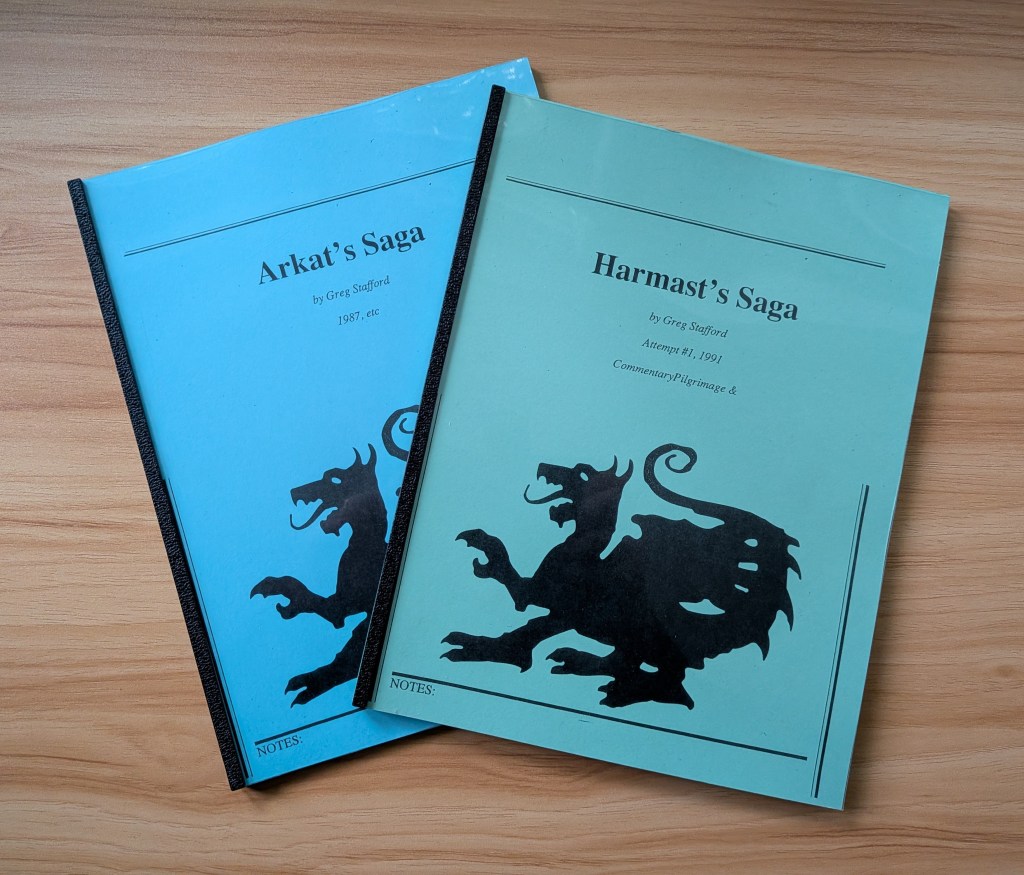
Arkat’s Saga, cover date “1987, etc”, and Harmast’s Saga, cover date “1991″
Towards the end of this period, away from the gaze of the most of his audience, Greg was working on a very different approach to Glorantha, returning to the fiction-first approach of the Roots period. Early text for Arkat’s Saga is dated 1987-1990, with writing for Harmast’s Saga following shortly afterwards.
Exploration through archaeology
1992 to 1995.
This period is popularly known as the RuneQuest Renaissance. It was open mostly to others to expand upon Glorantha in print, and with the exception of Dorastor, the results were very localized, starting with Sun County (1992) and generally not venturing very far from that general area. Many of the authors were left to do their own thing:
“[Sun County?] I have seen it, but haven’t studied it. It looks quite good; all my hard-core Glorantha mates think its great”. 13
Fan publishing also began to make an initial impact: Tales of the Reaching Moon (1989-2002); RQ Adventures (1993-1998); Codex (1994-1995); New Lolon Gospel (1995-1996). For the most part, the fan authors saw Glorantha as a territory ready for further exploration: consistency maintained where possible, but with freedom to set out along many different creative pathways.
During this period Greg embarked on a new set of journeys into the world’s hidden depths and mysteries, conducting a series of speculative archaeological investigations to better understand parts of the world that had not previously been properly explored.
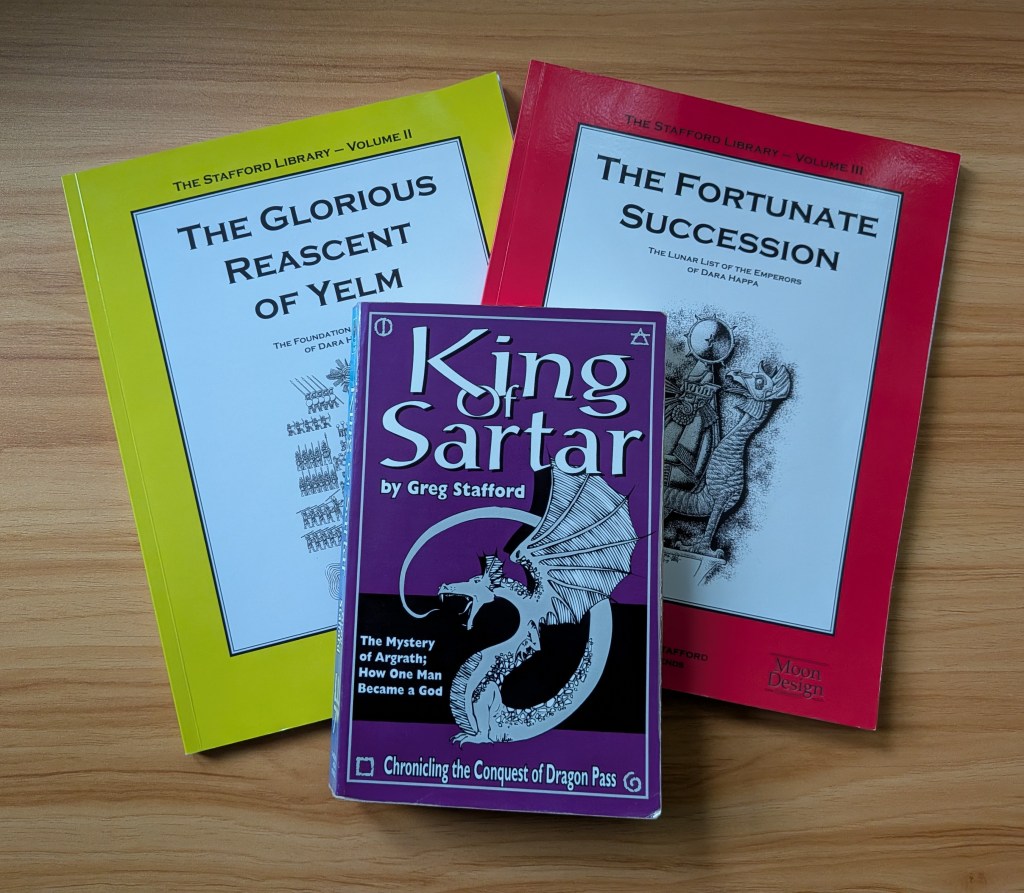
The Glorious Reascent of Yelm, The Fortunate Succession, and King of Sartar (the original edition)
This began with King of Sartar (1992), which explored the future but also shared far more information for Dragon Pass than had been published since 1975, and then Glorious ReAscent of Yelm (1994) and The Dara Happan Book of Emperors (1994, renamed The Fortunate Succession in 1995). These works sought to unearth (or explore more deeply) historical and mythic perspectives well beyond those from the previous phase.
Each of these had a specific quarry in mind: King of Sartar to better elucidate the past, present and possible future of the Sartarite Orlanthi; and Glorious ReAscent and others to reveal archaeological strata that underly the Lunar Empire. The latter were created as part of a never-completed project to publish an in-depth Lunar Book.
There were collaborators, with some of these books credited to “& friends”, but for the most part this feels like a return to the initial period of the solo historian. Jeff Richard has suggested that as the commercial failure of Chaosium’s deal with Avalon Hill became increasingly clear, Greg’s interest in wider publication of his own material diminished. This allowed a return to a more experimental investigation of the world. 14
If Roots of Glorantha had remained largely buried deep underground (the texts would first be circulated in any significant way only in 2007), Greg’s new “unfinished works” found a small but dedicated audience of enthusiastic fans (and a handful of collaborators). Prepared largely as “deep background”, in-world texts retrieved from a mythic prehistory, they would sometimes later be read as holy writ in a way that I think was never really intended.
Resplendent in divergence?
1997 to 2007.
The short-lived RuneQuest Renaissance was over. In 1997, Greg Stafford founded a new company, Issaries Inc., to hold the rights to Glorantha and publish an entirely new game.
Glorantha began to diverge. David Dunham’s King of Dragon Pass computer game (1999) explored its own view of the setting, and fan publications flowered: Tradetalk (1996-2009); Enclosure (1997-1998); Ye Booke of Tentacles (1998-2006); The Unspoken Word (2001-2004). Many different visions of the world, some again in collaboration with Greg, but mostly their own thing. This productive flowering largely ceased when Issaries Inc issued its infamous Fan Policy in 2005.
For “core” Glorantha, this period may seem like another period of consolidation, but with hindsight I think it is something different. My impression is that Greg seems to have been content to sit much more in the background.
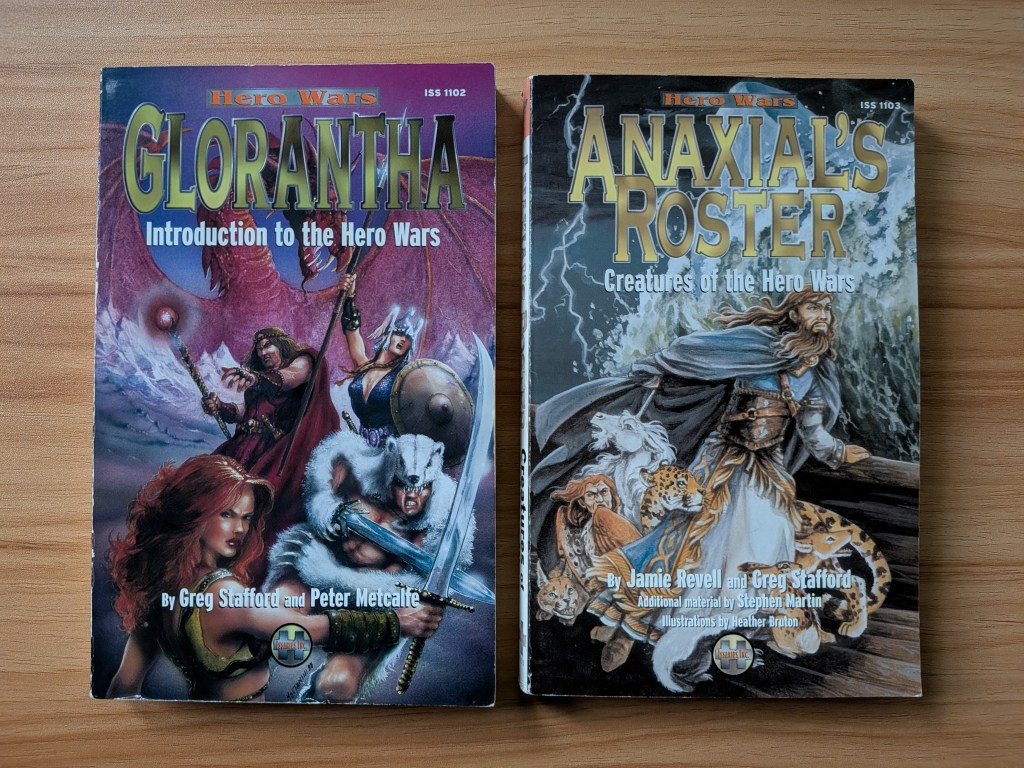
Glorantha: Introduction to the Hero Wars, by Stafford & Metcalfe, and Anaxial’s Roster, by Revell & Stafford. Cover art by Angelo Montanini (left) and Heather Bruton (right)
The world was defined and redefined by others with Greg’s benevolent oversight: Peter Metcalfe’s Glorantha: Introduction to the Hero Wars (2000); Jamie Revell’s Anaxial’s Roster (2000); and then numerous others contributing to Thunder Rebels, Storm Tribe, the Imperial Lunar Handbooks, Blood Over Gold etc. It seems as though the Great Compromise was being rewritten, with the perspective of Glorantha from King of Sartar and The Stafford Library seen here somewhat refracted.
“I don’t have the time or inclination to scrutinize everything, and it’s been an interesting piece of introspection to see what I really care about. And the answer to that is that I really care about the facts of Glorantha, but the interpretation of those into the various game formats is of less interest.
“So when it comes to already-established Gloranthan history, or a list of cities of Slontos, then I care a lot. If it’s a method to portray magic, I care less. And finally, I am also willing to accede to authors’ suggestions and desires and change things if the reasons are good enough”. 15
With less editorial restraint, we got “based on the works and ideas of Greg Stafford”. And many of these visions would later be rowed back, when the next phase of consolidation returned.
A wild Mongoose chase
2006 to 2010.
I’ve read very little from this period, but I get the impression that the trend set in the previous phase extended further. Other scholars here began to explore Glorantha’s Second Age in detail, very much in the “based on” mode.
“We agreed to have Mongoose do the Second Age in large part because I have done very little on that era, and thus they can have a lot more creativity with much of the material. (Learning to let go a little bit and allow the authors more leeway to express their own creativity—within the “laws” of Glorantha of course—has been one of my long lessons to learn in this biz.)”16
The consolidation era
2009 to 2017.
The “RuneQuest Effect” 17 has been described as being when the intrusion of an ever-growing number of subjective voices into Glorantha causes the integrity of the world itself to splinter. In Gloranthan history, these end-of-Age periods lead to catastrophe, followed by the consolidation that marks the beginning of a new Age.
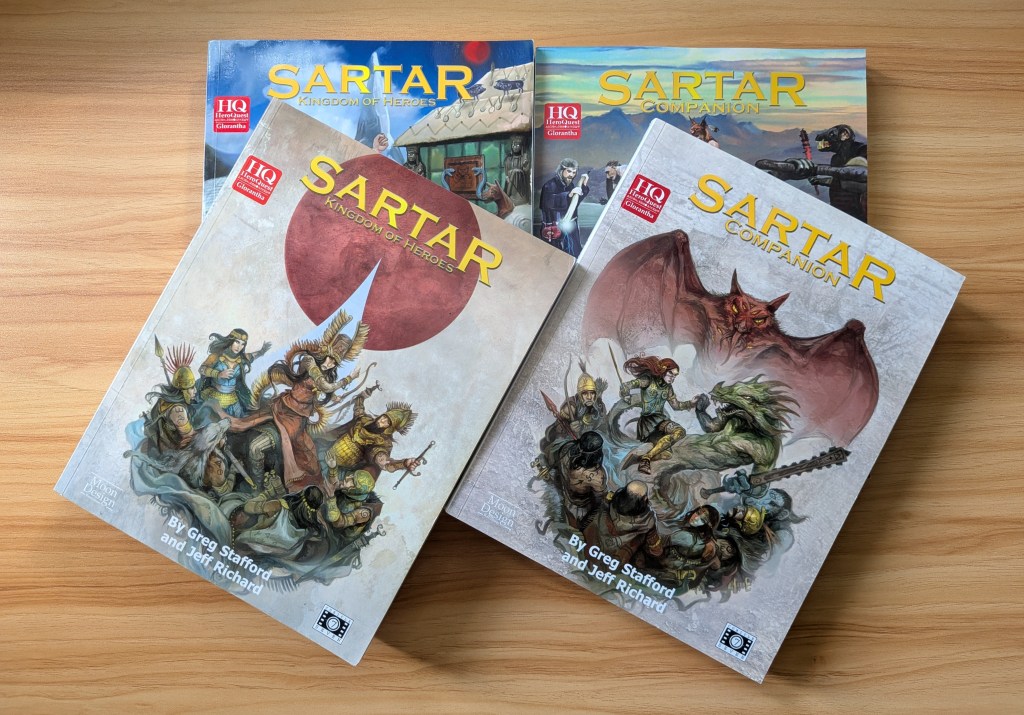
The previous two periods (Issaries and Mongoose) had led to an increasingly splintered Glorantha. In this new period, Jeff Richard began to restore order to the world, beginning yet again with the lands of Dragon Pass and Prax first explored over three decades previously: Sartar: Kingdom of Heroes (2009), Sartar Companion (2010), Pavis: Gateway to Adventure (2012). These were followed by two further campaign books set in Sartar in 2016-2017. No wonder Dragon Pass is the central site of mythic conflict in Glorantha: even the scholars constantly battle to redefine what’s there.
Sartar books from the “consolidation era”. Only collector fools need the alternate covers! Cover art by Simon Bray (above) and Jon Hodgson (below)
There seems to be a clear effort here to go from “based on” back towards “adhering to”, but there are still plenty of trappings of the 2000 to 2007 period that hadn’t yet been deprecated.
The second age of canon
2014 to date.
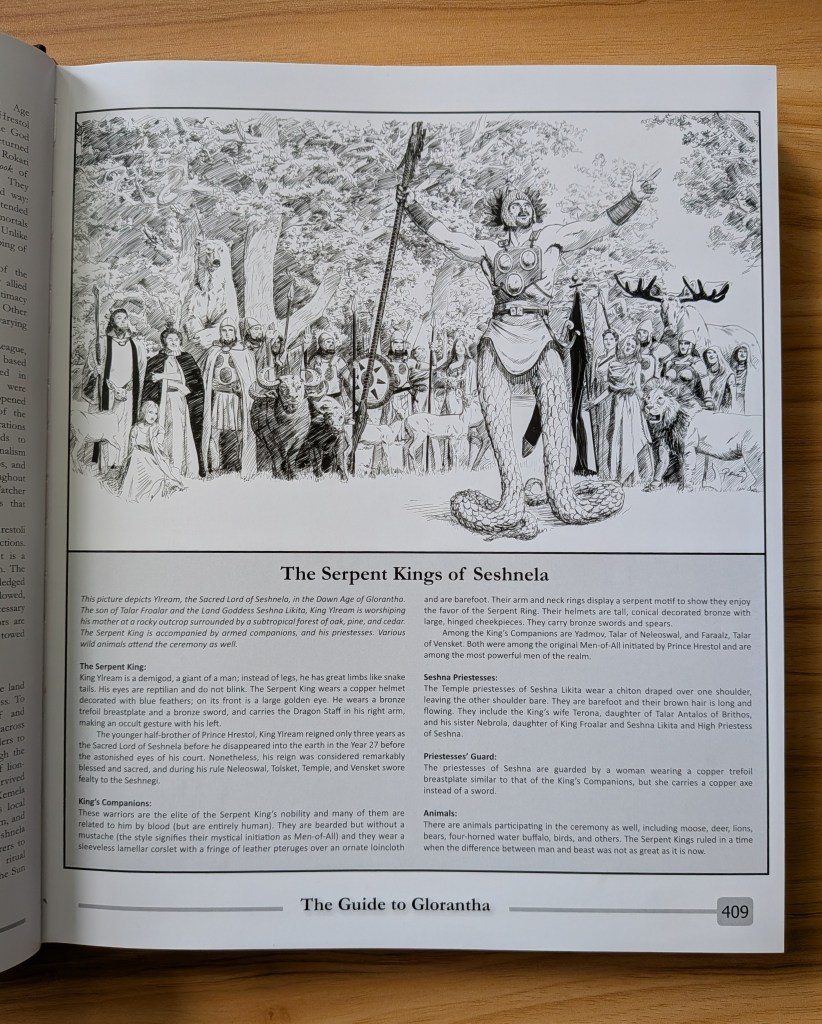
This most recent age began with Glorantha’s first official encyclopaedia: The Guide to Glorantha. A monolithic compendium of holy writ 18 that opened the way to a series of further definitive texts, the RuneQuest: Roleplaying in Glorantha line.
King Ylream, in The Guide to Glorantha, with his appearance inspired by legends of the serpent-tailed Athenian kings like Cecrops and Erichthonius. When first encountered many years earlier in The Reign of King Ylream, written in the late 1960s, Ylream rode upon the back of a young dragon. Illustration by Mike Perry
The Guide draws upon pretty much every era of previous Gloranthan writing and publication, but its heart is the first age of canon, the Avalon Hill big boxed sets.
“As far as my vision and outlook goes in presenting the vast world that I saw back in 1966, I could never really do it. I really had been trying to publish this book for 45 years and never succeeded until I got out of the way and let some other people let their own powers loose in this world. The result is this book, which I am just totally chuffed about”. 19
I think no previous period of (official) Gloranthan publication has depicted the world with such consistency (and in many cases, this level of definition). Other voices contribute, but the level of editorial control is very tight. There is no equivalent (yet) of a modern Griffin Mountain or a Sun County i.e. major campaigns and sourcebooks written by other authors but released by Chaosium itself.
The Golden Age
2019 to date.
The Jonstown Compendium community content program allows other explorers of Glorantha to record and share their own discoveries with official consent and support. There is a river of fan material that presumably began in 1978 (game write-ups in APAs etc), although its own history is perhaps best recorded from 1986 (Rune Riter and Pavic Tales) onwards 20.
Over time, the flow has risen and fallen, sometimes even ceasing entirely for a short time. On numerous occasions sediments have washed across from Glorantha-alternative into Glorantha-prime.
At its peak, the Gloranthan fan publications of the 1990s and early 2000s ran to around 500 pages of content in a year. In one quarter of 2023 alone, the Jonstown Compendium published over 1500 pages of material 21, and I suspect the rate must have increased since then.
Since 2019 this fan material has become a torrent, to the extent that the volume of Glorantha-alt knowledge dwarfs the volume of material being presented in the current phase of canon. The “monomyth” version of Glorantha proceeds on its way slowly and deliberately, but the “opening up” period that in the past has followed on from such a phase is instead now happening simultaneously.
Notes
“Opening up” and “closing down” are both creative acts, and never as readily separable as suggested in this short history. They are both fundamental to the creative method: invention, and decision-making. Design requires both imagination and synthesis.
Everything in Glorantha emerges from the font of Chaos before being placed into order as part of a Great Compromise. Sometimes a struggle must take place first, to resolve conflicting possibilities.
This history necessarily simplifies those phases of creativity, and concentrates on an axis of solo vs collaborative creation. There are other measures that could be explored:
simplicity (monomyth) vs multiplicity and ambiguity of in-world “truth”.
the general tendency towards “canon”, and away from what was once called GAG (“generally accepted Glorantha”), or from the increasing incoherence of some periods (I’m suggesting that these trends emerge directly in response to previous phases where looser, collaborative creativity led to an incoherent IP).
creation through the generation of an archaeological record (Roots, Stafford Library) vs through direct exploration of the ruins (adventures and game playing).
breadth and depth of definition (a world to explore) vs the conscious provision of blank lands (a world to co-create).
the fossilisation of the past vs the ongoing desire to revise and refresh.
There is much more to be written regarding the history of unofficial Gloranthan creativity. This has perhaps paradoxically reached its current peak right alongside the strongest ever official commitment to understanding and presenting the setting in a coherent, accessible and comprehensive manner.
I’m wondering whether there’s a new and more sustainable model here that’s very different to the ebb-and-flow, the breathing in and out, of previous development.
I also think there is substantially more scope for alt-Gloranthas to emerge than the creative community seems willing to consider. Perhaps the community content model embraced in this new Golden Age encourages creators to direct their attention towards the marketplace rather than to pursue flights of fancy that stray further afield.
A Brief History of Chaosium, Inc, The Stafford Codex website, undated. Note that elsewhere, Greg said that “I have been writing an epos of generally unpublishable sorts for going onto ten years now. These writings form the general background for White Bear and Red Moon, strengthened by certain realizations I have had over the years concerning the reality of mythology” – Wyrm’s Footnotes #1, 1976. ↩︎
“All sword and sorcery is cliches”, Greg quoted Jessica Salmonson of [The Literary Magazine of]Fantasy and Terror as responding to his submission – see Wyrm’s Footnotes #1. ↩︎
Interview with Ian Livingstone in White Dwarf #17, 1980. ↩︎
Autumn / Fall 2026 is the 60th anniversary of the discovery of Glorantha. I think that is worth celebrating.
And that means celebrating Snodal.
I have been to the very edge of the world, far beyond the most northern lands of men, beyond even the endless lands of the eternal winter.
I was driven from the battlefield where I had fought alongside my valiant brother, forced northwards to escape the victorious barbarians.
In the winter lands I was taken captive by the ice god and his snow demons, and escaped only when freed by ancient demigods there, the Altinae. They live beyond the ice, and they know of gods whose names have long passed from our own memory.
Their land is a paradise of valleys, and orchards, and streams, and impossible towers, and yet it is a prison for them. They are punished for their failure to defend the world in the Long Night, when it faced its greatest peril.
Their library holds manuscripts beyond our scholars’ most hopeful dreams, endless shelves and stacks of knowledge of pasts and futures, and worlds beyond our imagination.
There I saw an atlas of the future, mapped by the wizard Zzabur. It showed our homeland destroyed, a great cataclysm that the wizard himself had planned. I learned that no ordinary man or woman could defeat the enemieswho still threated our homeland. But the return of my son, born to my Altinae Damosel, brings me true hope.
I will not wait to see how he fares. I will do what I can myself. With my friends Svenlos and Arthen, and my gifts from the Altinae, we have already settled affairs with my old foe, Black Hralf. Now I have spoken to the priests and the sorcerers, and we have our own quest. We will cut our enemies off from each other, destroy their unity, and prevent Zzabur’s plans from ever coming to pass.
I have seen paradise, and I wish my son to build such a world here, for all of us. I have faith that he might fulfil the promise that Hrestol himself first gave us those many ages ago.
Borne into Glorantha
“I wrote this one night in 1966 in a moment of creativity, and it bore me into Glorantha” – Greg Stafford 1.
It is now sixty years since Glorantha was first discovered, in the Fall of ’66. Eighteen-year old Greg Stafford had just started his studies at Beloit College, Wisconsin. He had recently returned from a hippy summer in Los Angeles, and he now wished to acquire the tools to become a writer 2. Perhaps he was also keen to do well enough at his studies to retain the 2-S selective service classification, an exemption from the draft for students who maintained good enough grades. Some of Greg’s friends had gone to ‘Nam, and he feared following them “more than anything else”3.
Greg was already an avid reader of books about sagas, myths and legends. By the time he arrived at college, he was already quickly exhausting the material he wanted to read 4:
“I was a young man full of energy and I was passionate about mythology. I had read everything I could find in mythology and was frustrated that I couldn’t find more.” 5
“I remember quite clearly sitting down at my desk to write a vignette. I still have that first page, in fact. It’s framed. That led to an explanation, which led to a story, which led to the blossoming of Glorantha.” 6
This first page had no obvious context. Initially, it was just a tiny fragment of a story, seemingly without any broader background or setting. Greg reported that he later “discovered” that the text portrayed people escaping from the destruction of the land of Seshnela at the end of Glorantha’s Second Age.
The fragment is a diary written by one of those survivors, fleeing from their “beloved homeland” with companions in a boat. Only seven of the group survive storms, waves, starvation, and an attack from a giant aquatic worm. They make landfall in the land that we now know as Fronela, some way to the north of Seshnela.
The birth of Snodal
Greg swiftly turned his attention to creating a much more detailed tale.
“It was Snodal. I remember it well. Snodal first.
“He found himself, one frozen evening, before a great guardian spirit which kept him from his past. He had no memory of that past, not of himself, or his nation.
“He had fought that great, mottled creature. Spirit. Draugr more like, twelve feet tall. It bore a double-bladed, two-handed axe, and wore only a loin cloth in the stinging snowstorm. It spat and drooled.
“But Snodal killed it, and so he got to Altinela. He bore with himself only one thing: a ragged fragment of his ancestor’s diary. This he matched to their records, and to find himself again Snodal began recording the history of his homeland”. 7
Once he had a character and some context, Greg’s drive quickly became to know more and more about his story and its setting.
“I wrote a little background about [Snodal], and then background about the background, and Glorantha started to gush out of my fingers towards the typewriter”. 8
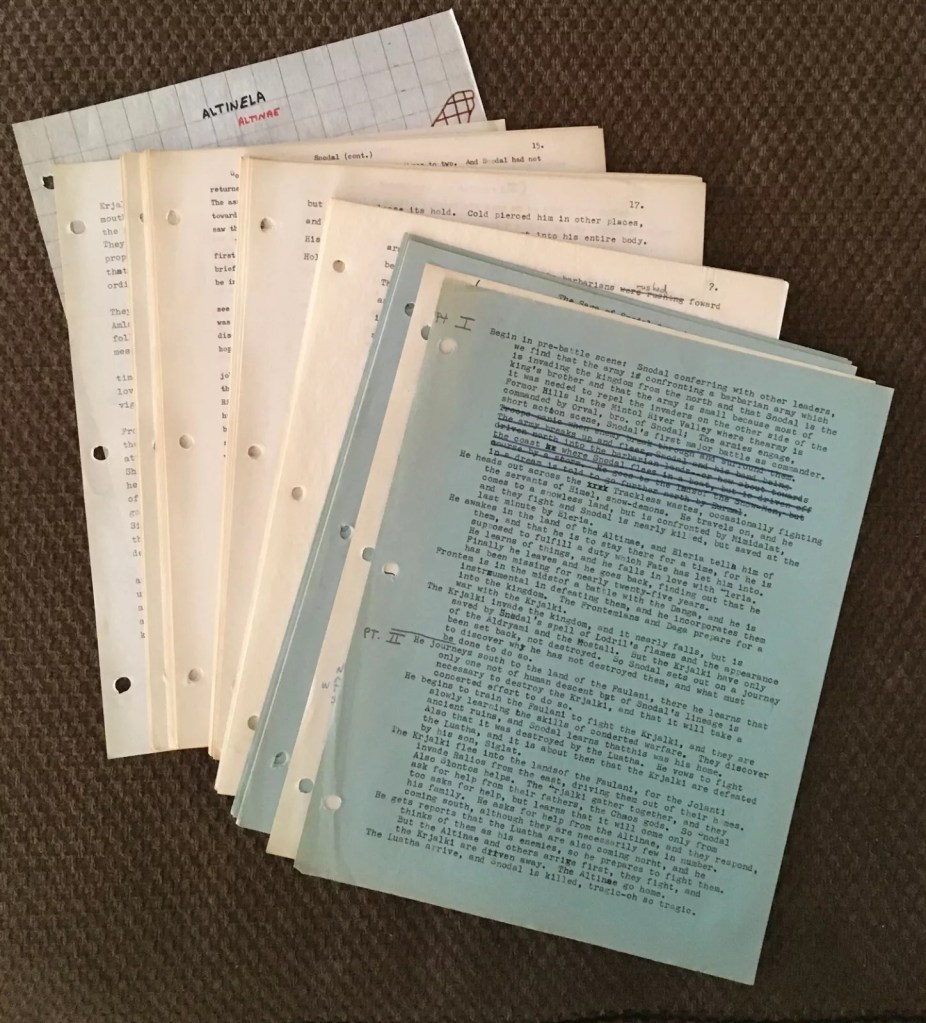
Pages from original typed Snodal text, source: eBay
Greg moved onto creating notes about Snodal’s homeland, Loskalm (called Frontem in these early tales). Very soon, the creative urge took Greg back to Seshnela, which would become the focus of his writing from roughly 1966-1969, during which time he finished at Beloit College, moving on to Southern Illinois University and then DePaul University.
Large volumes of Greg’s writings about First Age Seshnela were later collected in the Roots of Glorantha series, limited edition volumes first circulated in 2007. The contents were later reprinted as a reward for top-end Guide to Glorantha Kickstarter backers in 2015 9.
Those writings introduced people and peoples well known to fans from more widely available Gloranthan material, such as the Brithini, Vadeli, Argat (later Arkat), and Gbaji, amongst others. However, Snodal features only fleetingly in the Roots volumes.
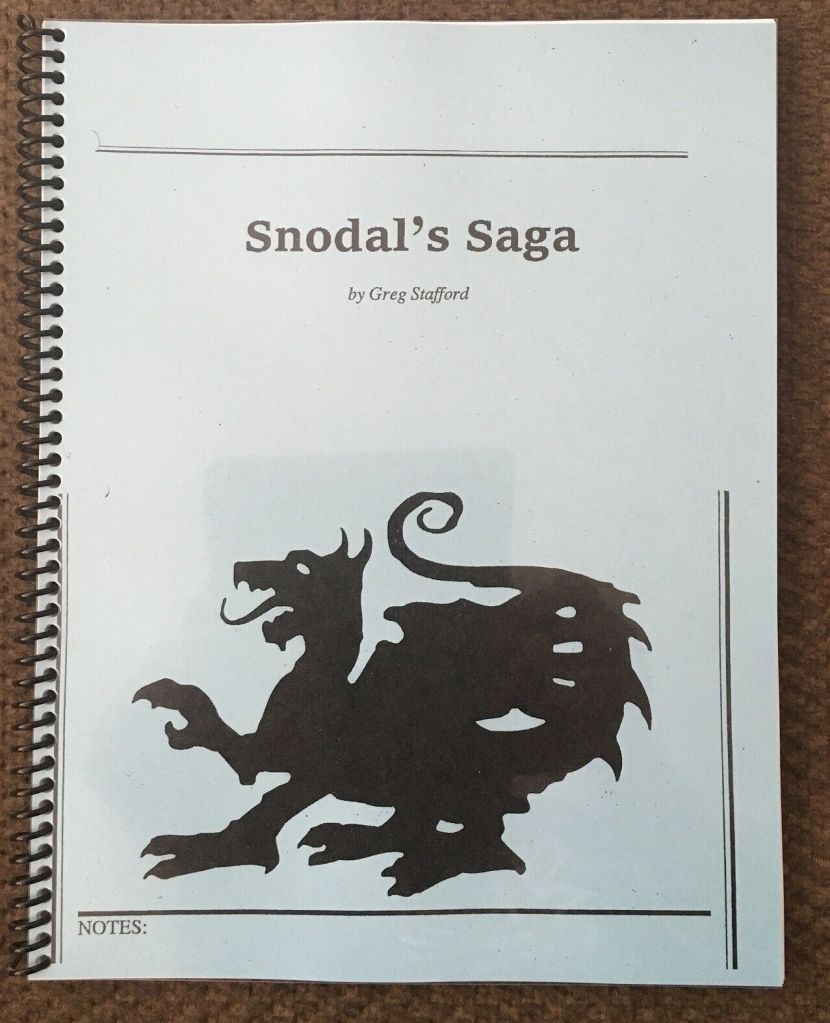
Much later, Greg compiled his early writings about Snodal and made them available to a very limited number of buyers in bound form as Snodal’s Saga. This is sufficiently rare that it doesn’t get a picture or even a mention on the Well of Daliath website or in the Meints Index to Glorantha. I’m not sure exactly when it was compiled and circulated.
Snodal’s Saga book cover, source: eBay
I understand that some of the same Snodal texts were also shared as “Deep Sources” with the top-level backers (“Heroes”) of the Glorantha Trading Association. The GTA was the membership structure founded in January 1999 to help fund the work of Issaries Inc.
A few photographs of some of the pages were shared when a copy of Snodal’s Saga was auctioned on eBay a couple of years ago. I’ve relied on those to help uncover a little about the early, not widely circulated Snodal material.
The opening text for this article is simply my own creative interpretation of the Snodal story.
In the original Snodal tale 10, the warriors of Frontem are confronted by barbarian “Jonati”. The Frontemians panic and are defeated when they mistake one of their own wizard’s explosive spells for enemy magic. Prince Snodal flees north with a barbarian, Ratskek, until the duo are eventually ambushed by hollri snow demons. Ratskek escapes, but Snodal is captured.
Snodal awakens, and is brought to Himel, the god of ice and cold, son of Nakala. Snodal is rescued when another god, Urtiam the law keeper, a representative of “The Nine”, intervenes.
Snodal awakens again, now rescued by a group of Altinae, including their Princess Eleria. The Altinae are descendants of the nine Great Gods of Acos 11. They take him to Altinela, where Eleria explains how the Altinae had feuded with another race of demigods, the Luatha, neglecting their duty to defend the world against Chaos. Ever since, they had been condemned by the Gods to forever defend the northern edge of the world from Chaos 12.
Many of the entities mentioned by Eleria in her conversation with Snodal survived into later Glorantha, albeit in many cases heavily revised: Humakt (here more of a prototype Umath than a death god), Zrethus (also spelled Zrenthus, a.k.a. Aether), Gata, Lodril, Ehilm, Urtiam (sometimes spelled Utriam), Hykim, Flamal, etc.
Snodal returns home from Altinela to find that his homeland, Frontem, is at war with the people of Danga. Snodal discovers that the Danga are themselves fleeing krjalki Chaos Demons, and he convinces both nations to unite against this common foe. With the power of the Frontemian wizards summoning the fire of Lodril, and aided by Aldryami and Mostali allies, the krjalki demons are defeated.
Snodal’s reunion with Ratskek appears briefly in one other tale that has been shared from the archives, the “Tale of Thanmor-Ratesk” 13. In this short tale Thanmor (a.k.a Ratskek) is reunited with Snodal after the Prince had returned to Frontem / Loskalm, helping him to defeat the krjalki 1415.
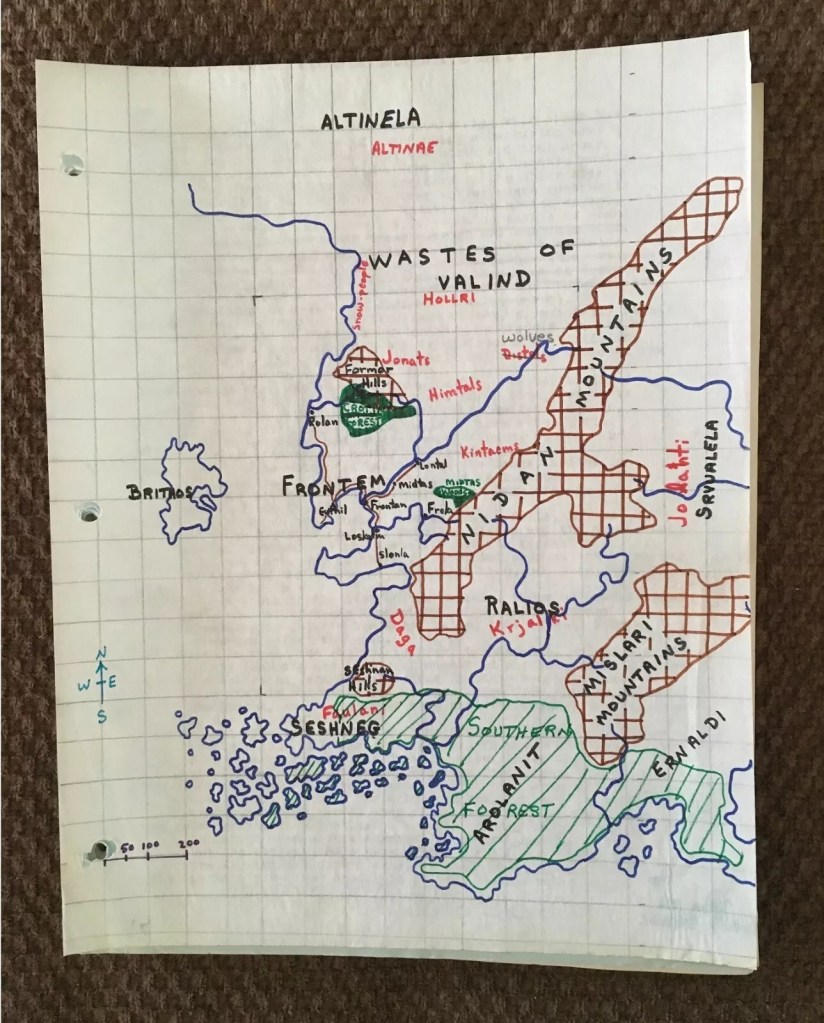
Original Greg Stafford map showing key places in the Snodal tale. Text in red indicates “peoples” or inhabitants. Source: eBay.
With the battle won, Snodal’s friend Svenlos visits an oracle and learns that the krjalki can only be permanently defeated by “one from another world”. This will presumably be Snodal’s son, Siglat, born in Altinela to both human and Altinae parents.
I guess this may all feel pretty arcane to many Glorantha fans, so I’ll try to summarise a few key points.
Snodal was the first Gloranthan hero to be described, active in a region of the world (north-western Genertela) that was pushed to the edge by later development. He leaves the mundane world and encounters gods and demigods, but without the intentionality of later heroes (notably Harmast and Arkat) – it’s a journey, not a quest. The entities he meets, the places he sees, and the timeline of events, read today like a scrambled version of our more familiar Glorantha. Although some elements of the tale are later discarded, and others heavily revised, I’m impressed quite how much of this first tale of Glorantha survived to define aspects of the more developed setting.
Inspiration for the Snodal saga
Greg claimed on several occasions that before he discovered Glorantha, he had never read any fantasy or science fiction.
“I had, however, read just about every European literature of the medieval and Greek eras.
“Iliad, Odyssey, Beowulf. Le Morte d’Arthur, Charlemagne, Mabinogion, Irish myths, Icelandic sagas, Geoffrey of Monmouth, Snorri Sturlasson, Saxo Grammaticus. That’s a good start”. 16
Elsewhere, he reports reading many of these classics first in grammar school, then in High School, before graduating to fantasy fiction only afterwards:
“In college I met Elric, then Bilbo and Frodo, then Conan, in that order. Those were the years when Lin Carter was editing the Adult Fantasy Series for Ballantine. I was lucky enough to get exposed to the old masters like Dunsany, Lovecraft, Smith, and then the rest of Moorcock’s tales”. 17
I don’t know whether the tale of Snodal was initially described as a “saga” or whether that term was added later, setting it alongside Greg’s later Jonat’s Saga, Arkat’s Saga and Harmast’s Saga. The Snodal tale does have some faint echoes of the Nordic sagas, several of which feature travels into the frozen north, including the land of the ice giants, Jotunheim. These resemblances seem partial at best, and I don’t think there is any direct parallel for the events, mythology or characters of Snodal’s Saga.
The land of Altinela resembles the Hyperborea of Greek myth: a beautiful and perpetually sunlit land found beyond the icy wastes of the north, populated by blessed people who lived for 1000 years.
Greg stated that he read the Elric stories at some point in 1966 18, so depending on the timing, I wonder whether this may have been the possible source of the Snodal Saga’s very early reference to “Chaos” within proto-Glorantha 19.
Snodal today
Setting aside the early material, what do we know about Snodal from more readily accessible material, now evolved into current Gloranthan canon? The current version of his story is similar, but not exactly the same.
Snodal doesn’t get an entry in Cults of RuneQuest: The Prosopaedia, relegated there to his role as father of Siglat, who became the founder of modern Loskalm and the utopian creed of New Hrestolism 20. Siglat’s mother was “an immortal called the Damosel of the Black Veil”, making Siglat a demigod (a semidemigod?): the child of a human and one of the Altinae.
Most of what is now readily available about Snodal can be found in The Guide to Glorantha. This clearly draws on the original version, but it has evolved to make sense when set alongside later understanding of the world.
According to The Guide, Snodal was a prince amongst the Loskalmi, who took part in a battle against the White Bear Empire in 1443, alongside his brother, King Orval. The Loskalmi were defeated by the barbarians, led by Black Hralf the Weasel, and Snodal fled north, ultimately to Altinela. While there, Snodal saw a map of Fronela, one generation into the future, with most of the land destroyed, and he vowed not to let this happen.
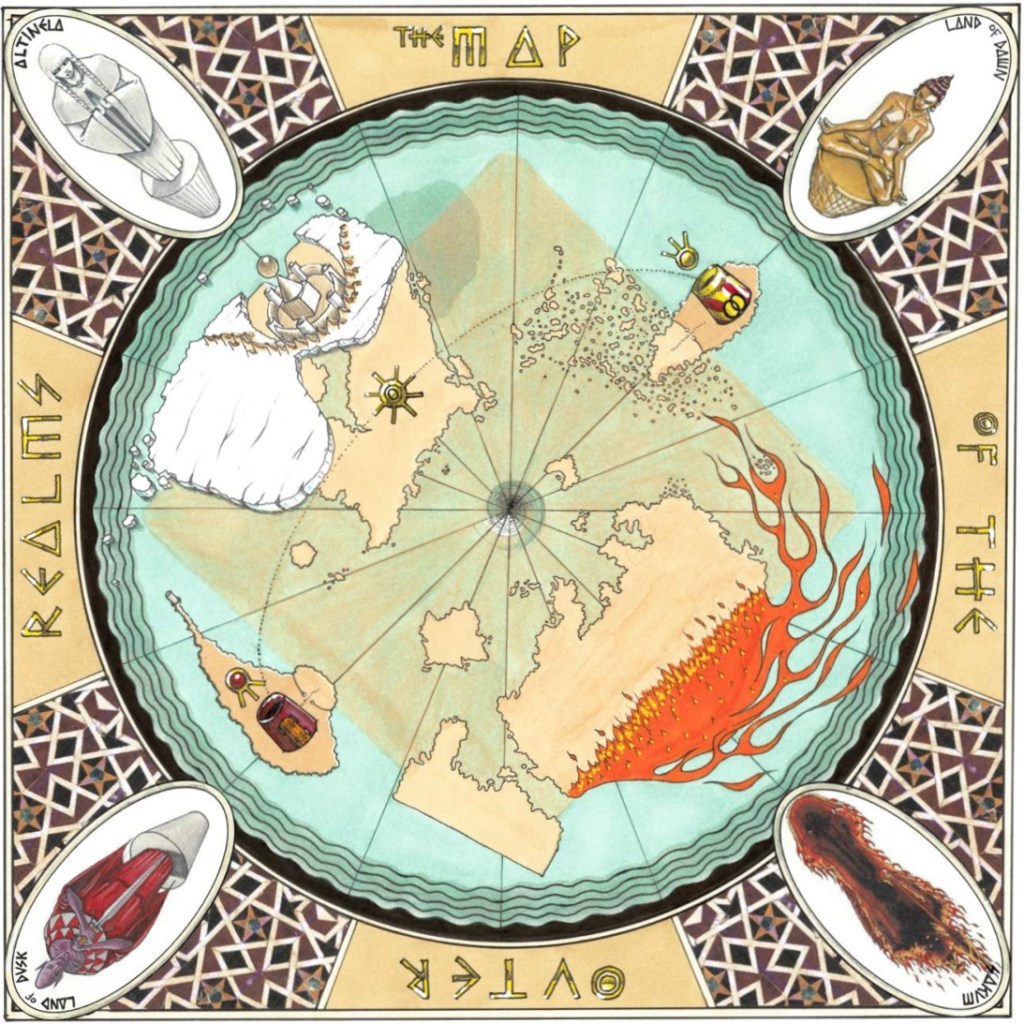
Map of the Outer Realms of Glorantha, showing Altinela, by Eric Vanel, source: The Guide to Glorantha, p159, (c) Moon Design Publications
Five years passed for Snodal while in the magical land of Altinela, but forty years passed in Fronela before he returned in 1483. Now aided by his friends and heroes Arthen and Svenlos, and magics gained from the Altinae, Snodal led his followers to victory against Black Hralf.
The “mysterious Damosel of the Black Veil”, one of the Altinae, arrived from Altinela with Snodal’s son, Siglat. The age of Siglat is unclear, but he would very soon become King of Loskalm.
Snodal discovered from a foreign priest that the map of the future held by the Altinae had been drawn up by the wizard Zzabur. It depicted the end-result of the wizard’s plans: to sink Fronela (the motivation is also unclear).
In 1499, Snodal led a heroquest with priests and sorcerers, killing the God of Silver Feet, a local trade and communications god.
Snodal is said to have then disappeared and never been seen again, although a mausoleum was built in his memory in the city of Ease. His heirs are reported to have summoned back his ghost, which explained that the heroquest had been necessary to thwart Zzabur’s plan (quite how this works is, yet again, unclear).
Meanwhile, the Syndics Ban descended upon all of Fronela, preventing communication across most of the land for many decades, over a century in some lands. This period of isolation allowed Snodal’s son Siglat’s new utopian Loskalm to develop safe from harm, at least until the Syndics Ban came to an end, revealing new enemies who had grown in secret …
Celebrating Snodal
I think we must be grateful to Prince Snodal for providing the spark in 1966 that grew and grew, drawing Greg Stafford deeper and deeper into Glorantha. The 60th anniversary is a great opportunity to pause, take stock, and celebrate.
I think it is regrettable that much of Snodal’s tale remains obscure, essentially available only to the fortunate few. His story feels like one that would still be worth reading (and this is really not true of all Greg’s early Gloranthan writing!)
(Hopefully that can be remedied one day.)
Even with the bare outline of his story set out in The Guide to Glorantha, I think Snodal is one of Glorantha’s more interesting characters. Which other mortals, if any, have travelled to a place like Altinela at the very edge of the world, and then returned? 21 Who else has heroquested to slay a god, and so prevent certain doom for his entire native land?
Although the early texts are inconsistent with our more modern understanding of the setting, they reveal or hint at possible further adventures. Snow demons! Chaos demons! An encounter with a god! Exploring a palace of ancient demigods! And plenty more.
Of Greg Stafford’s earliest writings, I definitely find these to be some of the more interesting, closest to a classic swords-and-sorcery tale of weird adventure.
Designer’s Notes, Glorantha: Genertela, Crucible of the Hero Wars, 1988. ↩︎
Interview with Franck Florentin, Christophe Seoane and Jérôme Bouscaut, in Jeu de Rôle Magazine #10, April / May 2010, translated with assistance from Stéphane Landelle. ↩︎
See also Cults of RuneQuest: The Prosopaedia, page 5, and The Guide to the Glorantha, pages 158-159. ↩︎
See https://wellofdaliath.chaosium.com/story-of-thanmor-ratesk/. In The Guide to Glorantha, Thanmor is listed as the son of Jonat, and so the second king of the Jonatings, who lived around 400 years before the time of Snodal. However, in this story Thanmor witnesses the battle between the “Frontemi” (an earlier term for the Loskalmi) and accompanies Snodal fleeing northwards. Perhaps this is an example of the shifting chronology of these early tales, or perhaps instead it’s just a different Thanmor entirely. Regarding the chronology, consider the “Daga” of the Thanmor-Ratesk tale, named the Daga / Danga in the original Snodal texts. They may or may not be related to the Dangans of around a thousand years earlier who we can find in the canonical Gloranthan chronology. They are a tribe or confederation in north-west Ralios. (If you have made it to the end of this footnote and are wondering whether it is really relevant – you are probably right to do so!) ↩︎
The “Ratesk” of this title is the barbarian “Ratskek” who accompanies Snodal to the north in one of the unpublished Snodal texts. These early writings are full of these connections and contradictions, artefacts of a fictional world being revised even while it was still being discovered. Coupled with typos, and names that got reused to refer to different characters or things entirely, nobody should expect complete coherence. ↩︎
The “krjalki” is another term used frequently in Greg’s early writings which often explicitly refers to some kind of “demon men”, or “Chaos demons”, spawn of a demon god. It also seems to sometimes be a generic term for non-human enemies. I guess that the “krjalki” that Snodal battled in early writings were later ret-conned to become the White Bear Empire, presumably sometime after the White Bear & Red Moon game was published. ↩︎
Back in 1966, there was no “Glorantha” as such. References to the world of these earliest stories are to “Acos”, evolving into “Glorinthael” and “Glorinthaela” in some of the Seshnela texts. ↩︎
Yes, this isn’t all just Gloranthan material. Want to make something of it?
This website is something I’ve been thinking about getting around to for a while. It’s a space for writing about Greg Stafford’s world of Glorantha, and the games and fiction that are set there.
Not writing for the games. Writing about the world and the games.
It’s a space for me to collect some of the existing material I’ve written that discusses the setting, and to expand upon that.
Why now? 2026 is the 60th anniversary of Greg Stafford’s discovery of Glorantha. This seems like an especially appropriate time to celebrate the setting.
Gloranthology could also be open to contributions from others, if I like them and find them interesting enough to share. Just hit the contact link if you are interested in submitting something.
Gloranthology aims to be respectful and contribute positively to discourse around Glorantha. But if you spot something that isn’t right, and should be corrected, again feel free to use the contact link.
Inevitably, this website will have an intimate relationship to trademarks and copyright material owned by Moon Design, Chaosium, and others. Hit the Copyright and Trademarks link to find out more about how I’m dealing with that.
The first proper post to appear will mark the 60th anniversary, by celebrating the character who I think was Glorantha’s first hero: Prince Snodal.